Mechanical Couplings
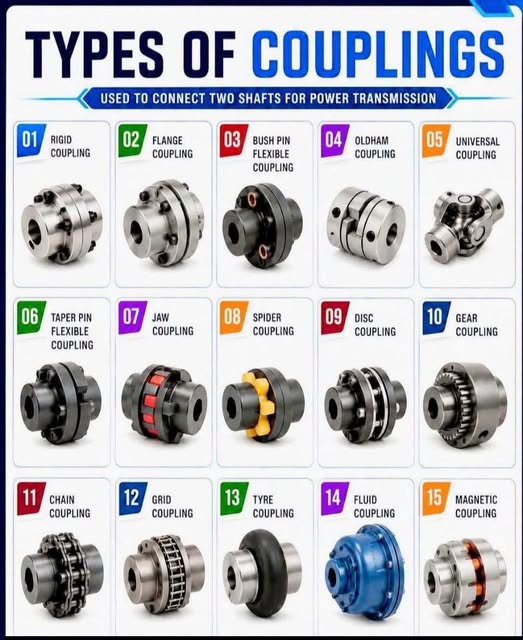
🔧 Understanding Shaft Couplings: The Backbone of Power Transmission In rotating machinery, shaft couplings play a critical role in transmitting torque while accommodating alignment challenges and operational loads. Selecting the right coupling is not just a mechanical choice—it directly impacts efficiency, reliability, and equipment life. Here’s a quick technical insight into commonly used coupling types:
✔️ Rigid Coupling – Best suited for perfectly aligned shafts. Offers zero flexibility, ensuring precise torque transmission but no tolerance for misalignment.
✔️ Sleeve (Muff) Coupling – A simple and economical solution for connecting two shafts inline. Ideal for light-duty applications with minimal alignment issues.
✔️ Flange Coupling – Designed for high torque transmission. Flanges are bolted together, making it suitable for heavy-duty industrial setups.
✔️ Flexible Coupling – Absorbs vibration, shock loads, and minor misalignment. Widely used to enhance machine life and reduce maintenance.
✔️ Jaw Coupling – Incorporates an elastomer (rubber spider) to dampen vibrations. Easy to install and commonly used in general-purpose machinery.
✔️ Gear Coupling – Built for high torque and heavy-duty applications. Provides slight misalignment tolerance with excellent durability.
✔️ Chain Coupling – Uses a chain and sprocket arrangement. Suitable for moderate loads and easy maintenance environments.
✔️ Oldham Coupling – Specifically designed to handle parallel misalignment with smooth power transmission.
✔️ Universal Coupling – Enables torque transmission between shafts at varying angles. Common in automotive and dynamic systems.
✔️ Tyre Coupling – Tyre couplings are widely used in heavy-duty industrial machinery such as pumps, compressors, conveyors, and mining equipment because they absorb vibration, compensate for misalignment, and ensure smooth power transmission.
✔️ Fluid Coupling – Uses hydraulic fluid to transmit power, allowing smooth starts and built-in overload protection.
💡 Key Selection Factors: - Misalignment (angular, parallel, axial) - Torque requirements - Operating speed - Shock & vibration load - Maintenance considerations 👉 Choosing the correct coupling is essential for optimizing performance and preventing premature failures. A small decision here can make a big difference in overall system reliability.